Skip to Constitution content
India 1947 โ€“ Till TodayPeople ยท Places ยท Documents ยท A More Informed Tomorrow My Archive

Constitutional learning collection ยท official-text boundary

Constitution
of India

Read the Preamble, navigate the constitutional structure and connect key Articles with the amendments that changed India's public institutions.

Explore the Constitution
Preamble 25 Parts Articles & amendments 12 Schedules 106 Amendments

Know your rights ยท key Articles

Illustration of founder Rahul Gautam presenting the Constitution of India collection
“A constitution is not just a rulebook โ€” it is a promise, renewed every time a citizen uses it to demand justice.” โ€” Rahul Gautam
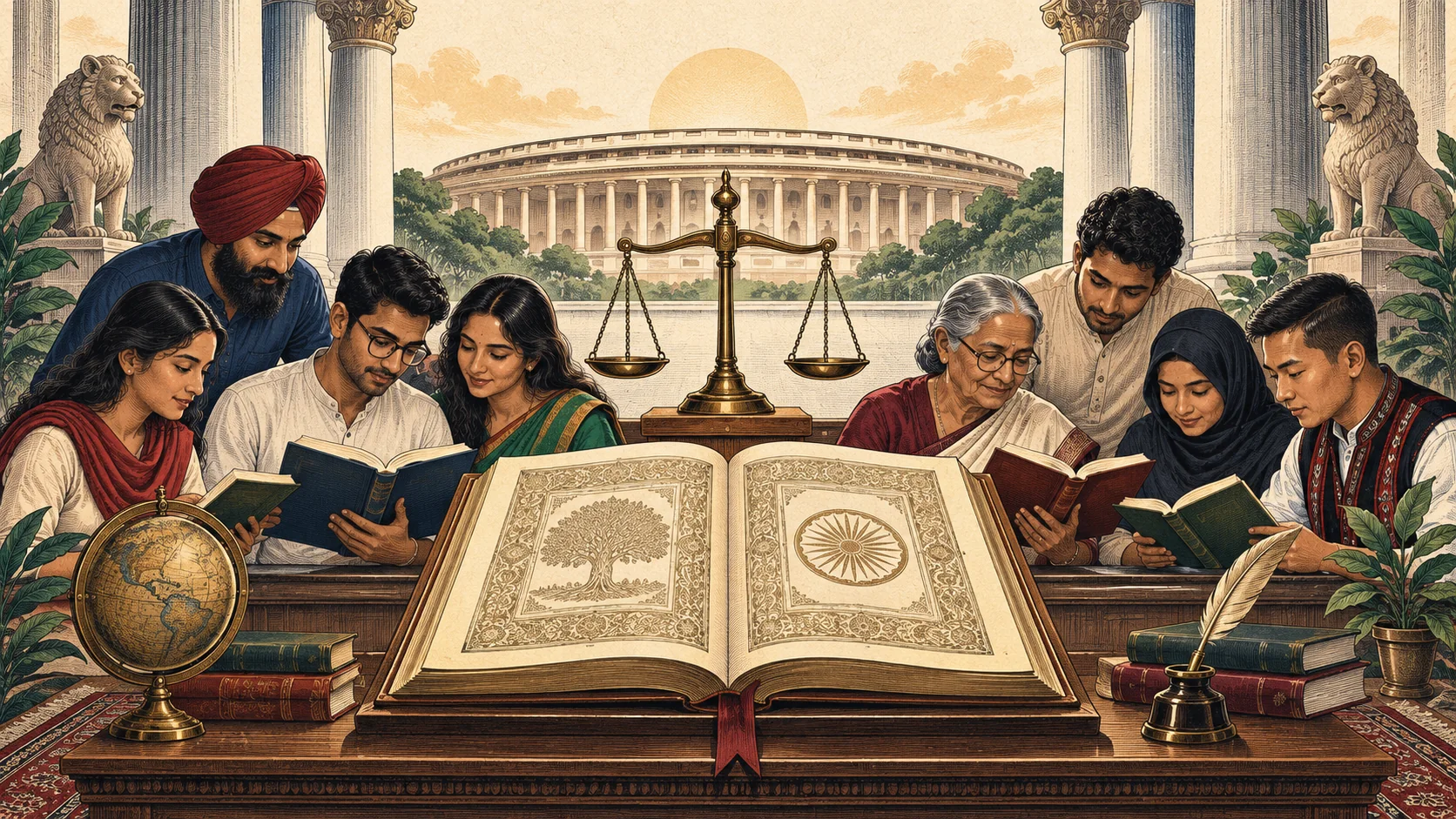
Editorial illustration of diverse citizens studying a constitutional volume beside the institutions of Parliament and justice
A living constitutional system connects the written text, public institutions, judicial interpretation and the people who use it.
Reading scope: this is a guided learning index of Parts and selected high-value Articles, plus a timeline of major amendments. For authoritative wording and every provision, use the official Constitution of India, updated through the 106th Amendment in the 2024 edition.
PREAMBLE
The Constitution of India ยท Adopted 26 November 1949
WE, THE PEOPLE OF INDIA, having solemnly resolved to constitute India into a SOVEREIGN SOCIALIST SECULAR DEMOCRATIC REPUBLIC and to secure to all its citizens:

JUSTICE, social, economic and political;

LIBERTY of thought, expression, belief, faith and worship;

EQUALITY of status and of opportunity; and to promote among them all

FRATERNITY assuring the dignity of the individual and the unity and integrity of the Nation;

IN OUR CONSTITUENT ASSEMBLY this twenty-sixth day of November, 1949, do HEREBY ADOPT, ENACT AND GIVE TO OURSELVES THIS CONSTITUTION.
Note: The words "Socialist" and "Secular" were added to the Preamble by the 42nd Amendment, 1976 during the Emergency. The word "Integrity" was also added at that time. The Supreme Court in Kesavananda Bharati v. State of Kerala (1973) held that the Preamble is part of the Constitution and its basic structure cannot be amended.
Click any Part to expand its key Articles. The Constitution has 25 Parts covering everything from citizenship to emergency powers. This guide indexes 21 active Part groupings and selected high-value provisions. Use search to find an indexed Article or topic.

Showing all 21 indexed Part groups

PART I The Union and its Territory Arts. 1โ€“4 +
Art. 1
Name and territory of the Union
India, that is Bharat, shall be a Union of States.
Art. 2
Admission or establishment of new States
Parliament may admit new States or establish new States on such terms and conditions as it thinks fit.
Art. 3
Formation of new States and alteration of areas
Parliament may form a new State by separation, union, or increase/decrease of area of existing States.
Art. 4
Laws made under Articles 2 and 3
PART II Citizenship Arts. 5โ€“11 +
Art. 5
Citizenship at commencement of Constitution
Art. 6
Rights of citizenship of certain migrants from Pakistan
Art. 7
Rights of citizenship of certain migrants to Pakistan
Art. 8
Rights of citizenship of certain persons of Indian origin
Art. 9
Persons voluntarily acquiring citizenship of a foreign State not to be citizens
Art. 10
Continuance of rights of citizenship
Art. 11
Parliament to regulate the right of citizenship by law
Parliament enacted the Citizenship Act, 1955. The CAA 2019 amended this act controversially.
PART III Fundamental Rights Arts. 12โ€“35 +
Art. 12
Definition of "State"
Fundamental Rights
Art. 13
Laws inconsistent with Fundamental Rights to be void
Establishes judicial review โ€” any law violating Fundamental Rights is void.
Fundamental Rights
Art. 14
Equality before law
The State shall not deny to any person equality before law or equal protection of the laws.
Fundamental Rights
Art. 15
Prohibition of discrimination
No discrimination on grounds of religion, race, caste, sex, or place of birth.
Fundamental Rights
Art. 16
Equality of opportunity in public employment
Fundamental Rights
Art. 17
Abolition of Untouchability
Untouchability is abolished and its practice in any form is an offence.
Fundamental Rights
Art. 18
Abolition of Titles
No title, not being a military or academic distinction, shall be conferred by the State.
Fundamental Rights
Art. 19
Protection of certain rights regarding freedom of speech
Guarantees 6 freedoms: speech & expression, assembly, association, movement, residence, profession.
Fundamental Rights
Art. 20
Protection in respect of conviction for offences
No ex-post-facto law, no double jeopardy, no self-incrimination.
Fundamental Rights
Art. 21
Protection of life and personal liberty
No person shall be deprived of his life or personal liberty except according to procedure established by law. The most litigated article in the Constitution.
Fundamental Rights
Art. 21A
Right to Education
Free and compulsory education for children aged 6โ€“14. Added by 86th Amendment, 2002.
Added by Amendment
Art. 22
Protection against arbitrary arrest and detention
Fundamental Rights
Arts. 23โ€“24
Right against Exploitation
Prohibition of traffic in human beings, forced labour, and employment of children in hazardous work.
Fundamental Rights
Arts. 25โ€“28
Right to Freedom of Religion
Freedom of conscience and free profession, practice and propagation of religion.
Fundamental Rights
Arts. 29โ€“30
Cultural and Educational Rights
Right of minorities to conserve their culture and establish educational institutions.
Fundamental Rights
Art. 32
Right to Constitutional Remedies
The "heart and soul" of the Constitution โ€” Dr. Ambedkar. Right to move the Supreme Court for enforcement of Fundamental Rights. Writs: Habeas Corpus, Mandamus, Prohibition, Quo Warranto, Certiorari.
Fundamental Rights
PART IV Directive Principles of State Policy Arts. 36โ€“51 +
Art. 38
State to secure a social order for welfare
Art. 39
Certain principles of policy to be followed
Equal pay for equal work; ownership of material resources distributed to serve common good.
Art. 39A
Equal justice and free legal aid
Added by 42nd Amendment, 1976.
Added by Amendment
Art. 40
Organisation of village panchayats
Art. 44
Uniform Civil Code
The State shall endeavour to secure a Uniform Civil Code for all citizens โ€” remains unimplemented, politically contested.
Art. 45
Early childhood care and education
Art. 48
Organisation of agriculture and animal husbandry
Prohibit slaughter of cows and calves โ€” basis of cow protection laws in several states.
Art. 51
Promotion of international peace and security
PART IV-A Fundamental Duties Art. 51A +
Art. 51A
Fundamental Duties (11 duties)
Added by 42nd Amendment (1976) โ€” originally 10 duties. 11th duty (for parents/guardians re: education) added by 86th Amendment (2002). Includes: abide by Constitution, cherish national ideals, uphold sovereignty, defend the country, promote harmony, preserve heritage, protect natural environment, develop scientific temper.
Added by Amendment
PART V The Union (President, Parliament, Courts) Arts. 52โ€“151 +
Art. 52
The President of India
There shall be a President of India โ€” the constitutional head of state.
Art. 53
Executive power of the Union
Art. 54โ€“55
Election and manner of election of President
Elected by electoral college of elected MPs and MLAs, using single transferable vote with proportional representation.
Art. 61
Procedure for impeachment of President
Art. 63
The Vice-President of India
Art. 72
Power of President to grant pardons
Art. 74
Council of Ministers to aid and advise President
The President acts on the aid and advice of the Council of Ministers headed by the Prime Minister.
Art. 75
Appointment of Prime Minister and Council of Ministers
Art. 79
Constitution of Parliament
Parliament = President + Rajya Sabha (upper house) + Lok Sabha (lower house).
Art. 80
Composition of the Rajya Sabha
Not more than 250 members โ€” 238 representatives of States/UTs + 12 nominated by President.
Art. 81
Composition of the Lok Sabha
The constitutional ceiling is 550 elected members: up to 530 from States and 20 from Union Territories. The former Article 331 Anglo-Indian nomination provision was removed by the 104th Amendment.
Art. 100
Voting in Houses, power of Houses to act notwithstanding vacancies
Art. 108
Joint sitting of both Houses
Art. 110
Definition of Money Bills
Art. 112
Annual financial statement (Union Budget)
Arts. 124โ€“147
The Supreme Court of India
Establishment, jurisdiction, composition, and powers of the Supreme Court. Chief Justice appointed by President. Currently has 34 judges including CJI.
Art. 148
Comptroller and Auditor-General of India (CAG)
PART VI The States Arts. 152โ€“237 +
Art. 153
Governors of States
Art. 154
Executive power of State
Art. 163
Council of Ministers to aid and advise Governor
Art. 164
Appointment of Chief Minister
Art. 168
Constitution of State Legislatures
Arts. 214โ€“231
High Courts in States
Art. 226
Power of High Courts to issue writs
PART VIII Union Territories Arts. 239โ€“242 +
Art. 239
Administration of Union territories
UTs administered by the President through administrators. Delhi and Puducherry have special legislative provisions.
Art. 239AA
Special provisions for Delhi
Added by 69th Amendment (1991). Delhi gets a Legislative Assembly but Lieutenant Governor has overriding powers over certain subjects.
Added by Amendment
PART IX Panchayats (Local Self-Government) Arts. 243โ€“243O +
Art. 243
Definitions relating to Panchayati Raj
Entire Part IX added by 73rd Amendment, 1992 โ€” gave constitutional status to Panchayati Raj institutions.
Added by Amendment
Art. 243D
Reservation of seats in Panchayats
Reservation for SC, ST, and not less than one-third for women in Panchayats.
PART IX-A Municipalities Arts. 243Pโ€“243ZG +
Art. 243Pโ€“243ZG
Urban local bodies โ€” Municipalities, Municipal Corporations
Added by 74th Amendment, 1992. Gives constitutional status to municipalities; mandates at least 1/3 seats for women.
Added by Amendment
PART XI Relations Between Union and States Arts. 245โ€“263 +
Art. 245
Extent of laws made by Parliament and Legislatures
Art. 246
Subject-matter of laws (7th Schedule โ€” 3 Lists)
Union List (97 subjects), State List (66 subjects), Concurrent List (52 subjects).
Art. 249
Parliament's power to legislate on State List
Art. 256
Obligation of States to comply with laws of Parliament
Art. 263
Provisions for Inter-State Council
PART XII Finance, Property, Contracts and Suits Arts. 264โ€“300A +
Art. 265
Taxes not to be imposed except by authority of law
Art. 267
Contingency Fund
Art. 280
Finance Commission
Constituted every 5 years to recommend distribution of taxes between Union and States.
Art. 300A
Right to property
No person shall be deprived of his property except by authority of law. Added by 44th Amendment (1978) โ€” right to property removed from Fundamental Rights to a constitutional right.
Added by Amendment
PART XIII Trade, Commerce and Intercourse Arts. 301โ€“307 +
Art. 301
Freedom of trade, commerce and intercourse
PART XIV Services Under the Union and States Arts. 308โ€“323 +
Art. 315
Public Service Commissions (UPSC, State PSCs)
Art. 320
Functions of Public Service Commissions
PART XIV-A Tribunals Arts. 323Aโ€“323B +
Art. 323Aโ€“323B
Administrative Tribunals
Added by 42nd Amendment (1976) โ€” provides for tribunals for adjudication of service and other matters.
Added by Amendment
PART XV Elections Arts. 324โ€“329A +
Art. 324
Superintendence of elections vested in Election Commission
The Election Commission of India โ€” independent constitutional body overseeing all elections.
Art. 326
Universal adult suffrage
Every citizen who is 18 years or above has the right to vote. Age lowered from 21 to 18 by 61st Amendment (1989).
Amended
PART XVI Special Provisions for Certain Classes Arts. 330โ€“342A +
Art. 330
Reservation of seats for SC and ST in Lok Sabha
Art. 332
Reservation of seats for SC and ST in State Legislatures
Art. 340
Appointment of Commission for OBCs
Basis for the Mandal Commission report and subsequent OBC reservations.
Art. 342A
Socially and Educationally Backward Classes (OBCs)
Added by 102nd Amendment (2018) โ€” gave constitutional status to National Commission for Backward Classes.
Added by Amendment
PART XVII Official Language Arts. 343โ€“351 +
Art. 343
Official language of the Union
Hindi in Devanagari script โ€” official language of the Union. English to continue for 15 years, later extended indefinitely by Parliament.
Art. 344
Official Language Commission
Art. 351
Directive for development of the Hindi language
PART XVIII Emergency Provisions Arts. 352โ€“360 +
Art. 352
Proclamation of Emergency (National Emergency)
President can declare National Emergency on grounds of war, external aggression, or armed rebellion. Invoked in 1962 (China war), 1971 (Pakistan war), 1975โ€“77 (Internal Emergency under Indira Gandhi).
Art. 356
President's Rule in States
Imposed when State government cannot function according to constitutional provisions. Has been used over 130 times since 1950, often controversially.
Art. 360
Financial Emergency
Can be declared if financial stability of India is threatened. Has never been invoked so far.
PARTS XIXโ€“XX Miscellaneous & Amendment of the Constitution Arts. 361โ€“368 +
Art. 361
Protection of President and Governors
Art. 368
Power of Parliament to amend the Constitution
The amendment procedure โ€” simple majority, special majority (2/3 + 50% of House), or special majority + ratification by half the State Legislatures. The Kesavananda Bharati case (1973) established the Basic Structure doctrine limiting amendment powers.
PARTS XXIโ€“XXII Temporary, Transitional & Special Provisions; Short Title Arts. 369โ€“395 +
Art. 370
Special provisions for Jammu & Kashmir
Originally gave special autonomous status to J&K. Abrogated by Presidential Order on 5 August 2019 โ€” J&K reorganised into two Union Territories (J&K and Ladakh). Supreme Court upheld the abrogation in December 2023.
Art. 371โ€“371J
Special provisions for various States
Includes special provisions for Maharashtra, Gujarat, Nagaland, Assam, Manipur, Andhra Pradesh, Sikkim, Mizoram, Arunachal Pradesh, Goa, Karnataka.
Art. 395
Repeals โ€” Government of India Act 1935, Indian Independence Act 1947
India has amended its Constitution 106 times since 1950. Filter by era or government below. Amendments marked Congress were passed under INC-led governments; BJP/NDA or Janata governments are noted where applicable.
1st Amendment1951Congress
Land Reforms & Restrictions on Fundamental Rights
Added 9th Schedule (protecting land reform laws from judicial review). Allowed reasonable restrictions on free speech. Enabled zamindari abolition. PM: Jawaharlal Nehru.
7th Amendment1956Congress
States Reorganisation
Reorganised States on linguistic lines following States Reorganisation Act. Abolished Part B States (princely states) and created new States. PM: Nehru.
24th Amendment1971Congress
Parliament's Power to Amend Fundamental Rights
Affirmed Parliament's power to amend any part of the Constitution including Fundamental Rights. Passed after Supreme Court's Golak Nath case (1967) had restricted amendment power. PM: Indira Gandhi.
25th Amendment1971Congress
Right to Property โ€” Acquisition
Limited courts' power to review compensation paid for property acquired by the State. PM: Indira Gandhi.
26th Amendment1971Congress
Abolition of Privy Purses
Abolished privy purses and special privileges of former Indian princes (rulers of princely states). PM: Indira Gandhi.
42nd Amendment1976Congress
"Mini Constitution" โ€” Emergency-era Sweeping Changes
The most controversial amendment. During the Emergency: added "Socialist" and "Secular" to the Preamble; added "Integrity"; added Fundamental Duties (Art. 51A); curtailed judicial review; gave Parliament supremacy over courts; added tribunals (Part XIV-A); made many other changes. PM: Indira Gandhi.
43rd & 44th Amendments1977โ€“78Janata Party
Reversing Emergency Excesses
Restored democratic safeguards curtailed during Emergency. 44th Amendment (1978): removed Right to Property from Fundamental Rights (Art. 19), placed it as ordinary right under Art. 300A. Made National Emergency proclamation harder โ€” required Cabinet recommendation in writing. PM: Morarji Desai.
52nd Amendment1985Congress
Anti-Defection Law (Tenth Schedule)
Added Tenth Schedule โ€” disqualification of members on grounds of defection. MPs/MLAs who vote against party directions or voluntarily give up party membership can be disqualified. PM: Rajiv Gandhi.
61st Amendment1988Congress
Voting Age Lowered to 18
Reduced the minimum voting age from 21 to 18 years โ€” enfranchising millions of young Indians. PM: Rajiv Gandhi.
69th Amendment1991Congress
Delhi โ€” National Capital Territory Status
Gave Delhi the status of National Capital Territory with a Legislative Assembly and Council of Ministers, but with limited powers compared to a full State. PM: P.V. Narasimha Rao.
Added Art. 239AA
73rd & 74th Amendments1992Congress
Panchayati Raj & Municipalities โ€” Constitutional Status
Added Part IX (Panchayats) and Part IX-A (Municipalities) โ€” gave constitutional recognition to local self-government. Mandated reservation for women (1/3 seats). Historic decentralisation of power. PM: P.V. Narasimha Rao.
77thโ€“80th Amendments1995โ€“2000United Front/NDA
Reservation in Promotions & Other Matters
77th Amendment: allowed reservation in promotions for SC/ST in government services. 79th Amendment: extended reservation in Lok Sabha/Assemblies by 10 years. 80th Amendment: revised tax-sharing formula (following 10th Finance Commission).
86th Amendment2002BJP/NDA
Right to Education โ€” Art. 21A
Made free and compulsory education a Fundamental Right for children aged 6โ€“14. Added Art. 21A. Led to the Right to Education Act, 2009. PM: Atal Bihari Vajpayee.
88th Amendment2003BJP/NDA
Service Tax in Union List
Added service tax to the Union List (7th Schedule). PM: Vajpayee.
97th Amendment2011Congress
Cooperative Societies โ€” Constitutional Status
Added right to form cooperative societies as a Fundamental Right; added DPSP and Part IX-B for cooperative societies. PM: Manmohan Singh.
99th Amendment2014BJP/NDA
National Judicial Appointments Commission (NJAC)
Created NJAC to replace the collegium system for judicial appointments. Struck down by Supreme Court in 2015 as unconstitutional โ€” Court held it violated judicial independence (basic structure). PM: Narendra Modi.
100th Amendment2015BJP/NDA
India-Bangladesh Land Boundary Agreement
Gave effect to exchange of certain territories with Bangladesh โ€” resolving a 68-year-old border dispute. About 111 enclaves in Bangladesh were transferred to India and vice versa. PM: Modi.
101st Amendment2016BJP/NDA
Goods and Services Tax (GST)
Introduced GST โ€” India's biggest tax reform since independence. Subsumed over 17 central and state taxes into one. Created GST Council. Effective 1 July 2017. PM: Modi.
102nd Amendment2018BJP/NDA
National Commission for Backward Classes โ€” Constitutional Status
Gave constitutional status to the National Commission for Backward Classes. Added Art. 338B and 342A. PM: Modi.
103rd Amendment2019BJP/NDA
10% Reservation for EWS (Economically Weaker Sections)
Added 10% reservation in education and government jobs for economically weaker sections of general category (those not covered by existing SC/ST/OBC quotas). Upheld by Supreme Court in November 2022. PM: Modi.
104th Amendment2020BJP/NDA
Extension of Reservation + Abolition of Anglo-Indian Seats
Extended reservation of seats for SC and ST in Lok Sabha and State Assemblies by 10 more years (from 2020 to 2030). Also ended nominated Anglo-Indian seats in Parliament and State Assemblies. PM: Modi.
105th Amendment2021BJP/NDA
States' Power to Identify OBCs Restored
Restored States' power to identify and specify socially and educationally backward classes (OBCs) โ€” after the Supreme Court's Maratha quota ruling had suggested only Centre could do so. Amended Arts. 338B, 342A, 366. PM: Modi.
106th Amendment2023BJP/NDA
Women's Reservation โ€” 1/3 Seats in Lok Sabha & State Assemblies
The Nari Shakti Vandan Adhiniyam โ€” reserved one-third of seats for women in Lok Sabha, State Legislative Assemblies, and Delhi Assembly. Added Arts. 330A, 332A, 334A. Implementation deferred to after the next delimitation exercise (expected post-2026 census). PM: Modi.

Showing selected major amendments for study. The official 2024 text incorporates amendments through the 106th Amendment; omitted amendments should not be assumed routine or unimportant.

The Constitution has 12 Schedules โ€” annexures that contain detailed provisions supporting the Articles. Several schedules have been added by amendments.
First Schedule
Names of States & Union Territories
Lists all States and Union Territories of India with their territories. Updated as States are reorganised or UTs are created/converted.
Second Schedule
Salaries of Constitutional Authorities
Salary, allowances and privileges of President, Governors, Speaker, Deputy Speaker, Chairman of Rajya Sabha, Supreme Court and High Court Judges, CAG.
Third Schedule
Forms of Oaths & Affirmations
Prescribed forms of oaths for Union and State ministers, MPs, MLAs, and judges of the Supreme Court and High Courts.
Fourth Schedule
Allocation of Seats in Rajya Sabha
Number of seats allocated to each State and Union Territory in the Rajya Sabha (Council of States).
Fifth Schedule
Administration of Scheduled Areas & Tribes
Provisions for administration and control of Scheduled Areas and Scheduled Tribes in states other than Assam, Meghalaya, Tripura, and Mizoram.
Sixth Schedule
Administration of Tribal Areas (NE States)
Provisions for administration of tribal areas in Assam, Meghalaya, Tripura, and Mizoram โ€” Autonomous District Councils with significant legislative powers.
Seventh Schedule
Division of Powers โ€” Three Lists
Union List (100 subjects): defence, atomic energy, railways, foreign affairs, currency, etc.
State List (61 subjects): police, land, agriculture, health, local government, etc.
Concurrent List (52 subjects): education, forests, trade unions, criminal law, etc.
Eighth Schedule
Official Languages of India (22 languages)
Lists the 22 officially recognised languages: Assamese, Bengali, Bodo, Dogri, Gujarati, Hindi, Kannada, Kashmiri, Konkani, Maithili, Malayalam, Manipuri, Marathi, Nepali, Odia, Punjabi, Sanskrit, Santali, Sindhi, Tamil, Telugu, Urdu.
Ninth Schedule
Acts Protected from Judicial Review
Added by 1st Amendment (1951). Lists laws (mainly land reform acts) that cannot be challenged in courts on grounds of violating Fundamental Rights. Currently contains 284 Acts. Supreme Court (I.R. Coelho case, 2007) held that laws added after April 24, 1973 can be challenged if they violate basic structure.
Tenth Schedule
Anti-Defection Law
Added by 52nd Amendment (1985). Grounds for disqualification of Members of Parliament and State Legislatures on account of defection from their party. The Speaker/Chairman decides disqualification petitions.
Eleventh Schedule
Powers of Panchayats (29 subjects)
Added by 73rd Amendment (1992). Lists 29 subjects over which Panchayats may be given powers, including agriculture, land improvement, rural housing, drinking water, primary education, libraries.
Twelfth Schedule
Powers of Municipalities (18 subjects)
Added by 74th Amendment (1992). Lists 18 subjects for Municipalities including urban planning, regulation of land use, public health, slums, urban poverty alleviation, vital statistics.